



bosaso becoming the new moqdishu
Moderators: Moderators, Junior Moderators
Forum rules
This General Forum is for general discussions from daily chitchat to more serious discussions among Somalinet Forums members. Please do not use it as your Personal Message center (PM). If you want to contact a particular person or a group of people, please use the PM feature. If you want to contact the moderators, pls PM them. If you insist leaving a public message for the mods or other members, it will be deleted.
This General Forum is for general discussions from daily chitchat to more serious discussions among Somalinet Forums members. Please do not use it as your Personal Message center (PM). If you want to contact a particular person or a group of people, please use the PM feature. If you want to contact the moderators, pls PM them. If you insist leaving a public message for the mods or other members, it will be deleted.
-
thehappyone
- SomaliNet Super

- Posts: 5196
- Joined: Mon Dec 02, 2013 6:00 am
- Location: Isle of Fernando
Re: bosaso becoming the new moqdishu
I'm just gonna sit here and wait for smooth's response.


Re: bosaso becoming the new moqdishu
it is pathetic when you have people you share nothing hate your guts,even little children know xamar has milder climate with an average room temperature of 24 and that 9 out of the 12 months it rains!! only baydhabo can compete with mog on weather mildness but even that city has water crisis problem and it is unsustainable if it grows too large.only march is hottest with an average of 27c.https://www.youtube.com/watch?v=zeCoBjoDXXYthehappyone wrote:I'm just gonna sit here and wait for smooth's response.
-
Cismaanbaqle
- Posts: 89
- Joined: Fri Oct 16, 2015 2:54 pm
Re: bosaso becoming the new moqdishu
Comparing Muqdisho with Bendar casim is laughable 
Muqdisho is an ancient city that was a central trading centre in the Indian Ocean trade. Its foundation is unclear, but is mostly associated with traders from the Indian Ocean region, like Arabs, Persians etc who settled in the Banadir coast region. The word Banaadir itself comes from the Persian word Bandar which means port, and refers to the port-cities of the Banadir region of Somalia.
Muqdisho was an extremely wealthy city that was a commercial hub in the Indian Ocean trade. The famous Arabian traveller Ibn Battuta visited this city in the 13th century and wrote about it:
"We sailed on from there for fifteen nights and came to Maqdashaw, which is a town of enormous size. Its inhabitants are merchants possessed of vast resources; they own large numbers of camels, of which they slaughter hundreds every day [for food], and also have quantities of sheep. In this place are manufactured the woven fabrics called after it, which are unequalled and exported from it to Egypt and elsewhere."
Muqdisho remained throughout the centuries an important trading centre, but lost its prominent role to other emerging trading centre’s in the Swahili coast. When the Portuguese entered the Indian Ocean trade in the 15th and 16th century, Muqdisho was not as wealthy as in the times of Ibn Battuta, but nonetheless remained an important commercial city. The city was wealthy from the overseas trade it drove based on its complementary relationship with the Ajuraan imamate of the interior. In the 16th and early 17th century, the city was ruled by the Muzzaffar dynasty which claimed its origin from Yemen, while the interior was ruled by the Ajuraan group. The Ajuraan ruled much of the Somali hinterland and succeeded in establishing their hegemony over the inter- riverine region.
‘Once established in the southern plains, however, the Ajuraan are said to have ruled the country from Qallaafo, on the upper Shabeelle river, to the shores of the Indian Ocean; and from Mareeg on the central Somali coast to the Jubba river in the south. (Cassanelli, pp90
The emergence of the Imamate of Yaaquub in Muqdisho is related to the tyrannical rule of the Ajuraan in the interior, and the attraction of the growing Muqdisho wealth as a consequence of its thriving trade controlled by the Muzzaffar dynasty which was allied to the Ajuraan in the interior.
The Yaaquub is a lineage of the Abgal clan who itself is part of the wider Darandoole Mudulood group. The Darandoole Mudulood is a pastoral group that lived in Central Somalia, and throughout the centuries migrated Southwards.As a consequence of this southwards migration, the Darandoole Mudulood encroached slowly but steadily on Muqdisho city and came in conflict with the Muzzaffar dynasty. This dynasty in Muqdisho was itself incapable to withstand this migration and encroachment and opted for negotiation with the Imam of the Darandole.
Cerulli has recorded traditional narrative of how the Darandole conquered Mogadishu against the Muzaffar dynasty:
“In ancient times the Sirasi lived in Mogadiscio. The people called Halawani succeeded the Sirasi. The Mudaffar succeeded the Halawani. The Mudaffar came from the country of Yemen in Arabia. He had guns. He built the palace that is found under the Governor’s house. He was a friend of the Aguran. At that time the Mudaffar governed the coast; and the Aguran ruled in the woodland. The Hirabe were not nearby them; they lived in the northern places. At that time the people of the woodland could not spend the night in the city of Mogadiscio. At sunset a ban was put on the city: ‘Hawiyya, it is growing dark! Hawiyya, it is growing dark!’ Then they went away toward the woodland.
“Later the Mudaffar had an interpreter who was called ‘Ismankäy Haggi ‘Ali. This ‘Ismankäy had the idea of letting the Darandollä enter the city. A message was sent to the imam Mahmud ‘Umar, who lived at Golol. The imam, guiding his Page: 71 warriors, came south and approached Mogadiscio. Then what did ‘Ismankäy do? He spoke with the Mudaffar: ‘By now the Darandollä are near Mogadiscio, let me be accompanied by some soldiers, and I shall go to them.’ ‘How do you want to do it?’ ‘I shall do it this way. I shall come to an agreement with the leaders and make them return to the places in the north.’ ‘So be it!’ said the Mudaffar. Then ‘Ismänkäy took some soldiers with him, but without weapons: ‘Leave your weapons! We go out to conclude an agreement, not really for war.’ They put down the weaons. They went into the woodland. When they had gone into the woodland, the Darandollä came out and took all the soldiers prisoner. Then they continued the raid and entered Mogadiscio. The Mudaffar was caputred and they wanted to kill him. But he, looking at the people who had come close to him, saw among them ‘Ismankäy Haggi Ali. ‘Stop!’ he said then. ‘Before you kill me, I want to speak. O ‘Ismankäy, you are good for nothing, you are capable of nothing, you will not pass seven!’ he said. Thus was 248 ‘Ismankäy cursed. When the Mudaffar was killed, when seven days passed after his death, ‘Ismankäy died too. It happened exactly as he had been cursed.
The Darandoolle have conquered Mogadishu city and killed the Muzzaffar governor sometime between 1590 and 1625. The approximate dates appear to be corroborated by a Portuguese document dated 1624.
After the Darandoolle Mudulood took control of the Mogadishu city in 1624, they quarrelled with the Ajuraan on the interior.
‘After entering Muqdisho, the Darandoolle quarrelled with the Ajuraan. They quarrelled over watering rights. The Ajuraan had decreed: ‘At the wells in our territory, the people known as Darandoolle and the other Hiraab cannot water their herds by day, but only at night’’…Then all the Darandoolle gathered in one place. The leaders decided to make war on the Ajuraan. They found the imam of the Ajuraan seated on a rock near a well called Ceel Cawl. They killed him with a sword. As they struck him with the sword, they split his body together with the rock on which he was seated. He died immediately and the Ajuraan migrated out of the country.
The Darandoolle became as such the first group to rebel against the tyranny of Ajuraan in the interior, and ever since this Ajuraan defeat other groups would follow in the rebellion which would eventually bring down Ajuraan rule of the inter-riverine region.
After the defeat of the Ajuraan in the interior the Darandoolle Mudulood established themselves around Mogadishu and Shabelle river valley, in which Wacdaan inhabited the environs of Afgoye and Muqdisho, Hilibi in Lower Shabelle, Moobleen went to the region now known as Middle Shabelle, while the Abgaal established themselves in and around Muqdisho city.
By about 1700 the entire political structure of Muqdisho city was altered with the ascendancy of a new line of Abgaal Yaaquub imams who established themselves in Shangaani quarter (the northern moiety of Muqdisho city). The Yaaquub imam’s powerbase remained among the people of the interior, while members of the Imam’s Yaaquub lineage intermarried with the BaFadel and Abdi Semen, two famed merchants families of Yemeni origins.
The Yaaquub Imam collected the port tariffs of the city, and emerged as the authority of Mogadishu city, despite its division into two moieties. The Yaaquub imamate would survive until the closing of the 19thcentury and was a force to reckon with when Zanzibari influence slowly expanded throughout the Banadir region.
‘ By the early years of the nineteenth century Muqdisho and the two other principal towns of the Benaadir coast, Marka and Baraawe, seem to have settled into a pattern of regular if modest trade with boats plying the maritime routes between India, Arabia, Lamu and Zanzibar. Exports included cattle,slaves, ivory andambergris.12 From two Soomaali traders from Baraawe whom he encountered at Zanzibar, Commander Thomas Smee learned in 181 I that Muqdisho ‘is not very considerable, may contain I 50 to 200 houses [by this he presumably means stone houses], it has not any river near it, and has but little trade’. He was also informed that it was governed by ‘a Soomaulee Chief named Mahomed Bacahmeen’, probably the reigning Abgaal imam.13 Despite its modest circumstances, Muqdisho was clearly larger than either Marka or Baraawe, the latter consisting of only about Ioo huts (as opposed to houses). By comparison, it is also worth noting that Smee’s informants could tell him that Luuq had some 300 huts.14This situation probably remained little changed until the following decade, when the fortunes of the Benaadir towns began to intertwine with the ambitious plans of Seyyid Said ibn Sultan for his East African legacy. Muqdisho, in particular, figured in two incidents which clearly established an atmosphere of mutual suspicion with the Omani rulers of Zanzibar. First, it seems, an Omani vessel ran aground north of Muqdisho and its entire crew was sent to that town for sale as slaves, only to be ransomed after a year in captivity by friends in Zanzibar, ‘who sent some stout negroes to replace them’. Then, in i823, the Omani fleet that was sent to subdue Mombasa dropped anchor at Muqdisho and its commander, Abdullah ibn Sulaiyim, kidnapped two community leaders who came on board his ship and imprisoned them at Zanzibar. A ransom of 2,000 Maria Theresa dollars was fixed for their release, though they were eventually freed by the Governor of Zanzibar at the request of the headstrong British naval captain W. F. W. Owen.15 Owen hoped to raise the entire Benaadir on behalf of the British cause in East Africa, as he saw it, and while he appears to have had some success at Baraawe, none was forthcoming from Muqdisho.’
Muqdisho is an ancient city that was a central trading centre in the Indian Ocean trade. Its foundation is unclear, but is mostly associated with traders from the Indian Ocean region, like Arabs, Persians etc who settled in the Banadir coast region. The word Banaadir itself comes from the Persian word Bandar which means port, and refers to the port-cities of the Banadir region of Somalia.
Muqdisho was an extremely wealthy city that was a commercial hub in the Indian Ocean trade. The famous Arabian traveller Ibn Battuta visited this city in the 13th century and wrote about it:
"We sailed on from there for fifteen nights and came to Maqdashaw, which is a town of enormous size. Its inhabitants are merchants possessed of vast resources; they own large numbers of camels, of which they slaughter hundreds every day [for food], and also have quantities of sheep. In this place are manufactured the woven fabrics called after it, which are unequalled and exported from it to Egypt and elsewhere."
Muqdisho remained throughout the centuries an important trading centre, but lost its prominent role to other emerging trading centre’s in the Swahili coast. When the Portuguese entered the Indian Ocean trade in the 15th and 16th century, Muqdisho was not as wealthy as in the times of Ibn Battuta, but nonetheless remained an important commercial city. The city was wealthy from the overseas trade it drove based on its complementary relationship with the Ajuraan imamate of the interior. In the 16th and early 17th century, the city was ruled by the Muzzaffar dynasty which claimed its origin from Yemen, while the interior was ruled by the Ajuraan group. The Ajuraan ruled much of the Somali hinterland and succeeded in establishing their hegemony over the inter- riverine region.
‘Once established in the southern plains, however, the Ajuraan are said to have ruled the country from Qallaafo, on the upper Shabeelle river, to the shores of the Indian Ocean; and from Mareeg on the central Somali coast to the Jubba river in the south. (Cassanelli, pp90
The emergence of the Imamate of Yaaquub in Muqdisho is related to the tyrannical rule of the Ajuraan in the interior, and the attraction of the growing Muqdisho wealth as a consequence of its thriving trade controlled by the Muzzaffar dynasty which was allied to the Ajuraan in the interior.
The Yaaquub is a lineage of the Abgal clan who itself is part of the wider Darandoole Mudulood group. The Darandoole Mudulood is a pastoral group that lived in Central Somalia, and throughout the centuries migrated Southwards.As a consequence of this southwards migration, the Darandoole Mudulood encroached slowly but steadily on Muqdisho city and came in conflict with the Muzzaffar dynasty. This dynasty in Muqdisho was itself incapable to withstand this migration and encroachment and opted for negotiation with the Imam of the Darandole.
Cerulli has recorded traditional narrative of how the Darandole conquered Mogadishu against the Muzaffar dynasty:
“In ancient times the Sirasi lived in Mogadiscio. The people called Halawani succeeded the Sirasi. The Mudaffar succeeded the Halawani. The Mudaffar came from the country of Yemen in Arabia. He had guns. He built the palace that is found under the Governor’s house. He was a friend of the Aguran. At that time the Mudaffar governed the coast; and the Aguran ruled in the woodland. The Hirabe were not nearby them; they lived in the northern places. At that time the people of the woodland could not spend the night in the city of Mogadiscio. At sunset a ban was put on the city: ‘Hawiyya, it is growing dark! Hawiyya, it is growing dark!’ Then they went away toward the woodland.
“Later the Mudaffar had an interpreter who was called ‘Ismankäy Haggi ‘Ali. This ‘Ismankäy had the idea of letting the Darandollä enter the city. A message was sent to the imam Mahmud ‘Umar, who lived at Golol. The imam, guiding his Page: 71 warriors, came south and approached Mogadiscio. Then what did ‘Ismankäy do? He spoke with the Mudaffar: ‘By now the Darandollä are near Mogadiscio, let me be accompanied by some soldiers, and I shall go to them.’ ‘How do you want to do it?’ ‘I shall do it this way. I shall come to an agreement with the leaders and make them return to the places in the north.’ ‘So be it!’ said the Mudaffar. Then ‘Ismänkäy took some soldiers with him, but without weapons: ‘Leave your weapons! We go out to conclude an agreement, not really for war.’ They put down the weaons. They went into the woodland. When they had gone into the woodland, the Darandollä came out and took all the soldiers prisoner. Then they continued the raid and entered Mogadiscio. The Mudaffar was caputred and they wanted to kill him. But he, looking at the people who had come close to him, saw among them ‘Ismankäy Haggi Ali. ‘Stop!’ he said then. ‘Before you kill me, I want to speak. O ‘Ismankäy, you are good for nothing, you are capable of nothing, you will not pass seven!’ he said. Thus was 248 ‘Ismankäy cursed. When the Mudaffar was killed, when seven days passed after his death, ‘Ismankäy died too. It happened exactly as he had been cursed.
The Darandoolle have conquered Mogadishu city and killed the Muzzaffar governor sometime between 1590 and 1625. The approximate dates appear to be corroborated by a Portuguese document dated 1624.
After the Darandoolle Mudulood took control of the Mogadishu city in 1624, they quarrelled with the Ajuraan on the interior.
‘After entering Muqdisho, the Darandoolle quarrelled with the Ajuraan. They quarrelled over watering rights. The Ajuraan had decreed: ‘At the wells in our territory, the people known as Darandoolle and the other Hiraab cannot water their herds by day, but only at night’’…Then all the Darandoolle gathered in one place. The leaders decided to make war on the Ajuraan. They found the imam of the Ajuraan seated on a rock near a well called Ceel Cawl. They killed him with a sword. As they struck him with the sword, they split his body together with the rock on which he was seated. He died immediately and the Ajuraan migrated out of the country.
The Darandoolle became as such the first group to rebel against the tyranny of Ajuraan in the interior, and ever since this Ajuraan defeat other groups would follow in the rebellion which would eventually bring down Ajuraan rule of the inter-riverine region.
After the defeat of the Ajuraan in the interior the Darandoolle Mudulood established themselves around Mogadishu and Shabelle river valley, in which Wacdaan inhabited the environs of Afgoye and Muqdisho, Hilibi in Lower Shabelle, Moobleen went to the region now known as Middle Shabelle, while the Abgaal established themselves in and around Muqdisho city.
By about 1700 the entire political structure of Muqdisho city was altered with the ascendancy of a new line of Abgaal Yaaquub imams who established themselves in Shangaani quarter (the northern moiety of Muqdisho city). The Yaaquub imam’s powerbase remained among the people of the interior, while members of the Imam’s Yaaquub lineage intermarried with the BaFadel and Abdi Semen, two famed merchants families of Yemeni origins.
The Yaaquub Imam collected the port tariffs of the city, and emerged as the authority of Mogadishu city, despite its division into two moieties. The Yaaquub imamate would survive until the closing of the 19thcentury and was a force to reckon with when Zanzibari influence slowly expanded throughout the Banadir region.
‘ By the early years of the nineteenth century Muqdisho and the two other principal towns of the Benaadir coast, Marka and Baraawe, seem to have settled into a pattern of regular if modest trade with boats plying the maritime routes between India, Arabia, Lamu and Zanzibar. Exports included cattle,slaves, ivory andambergris.12 From two Soomaali traders from Baraawe whom he encountered at Zanzibar, Commander Thomas Smee learned in 181 I that Muqdisho ‘is not very considerable, may contain I 50 to 200 houses [by this he presumably means stone houses], it has not any river near it, and has but little trade’. He was also informed that it was governed by ‘a Soomaulee Chief named Mahomed Bacahmeen’, probably the reigning Abgaal imam.13 Despite its modest circumstances, Muqdisho was clearly larger than either Marka or Baraawe, the latter consisting of only about Ioo huts (as opposed to houses). By comparison, it is also worth noting that Smee’s informants could tell him that Luuq had some 300 huts.14This situation probably remained little changed until the following decade, when the fortunes of the Benaadir towns began to intertwine with the ambitious plans of Seyyid Said ibn Sultan for his East African legacy. Muqdisho, in particular, figured in two incidents which clearly established an atmosphere of mutual suspicion with the Omani rulers of Zanzibar. First, it seems, an Omani vessel ran aground north of Muqdisho and its entire crew was sent to that town for sale as slaves, only to be ransomed after a year in captivity by friends in Zanzibar, ‘who sent some stout negroes to replace them’. Then, in i823, the Omani fleet that was sent to subdue Mombasa dropped anchor at Muqdisho and its commander, Abdullah ibn Sulaiyim, kidnapped two community leaders who came on board his ship and imprisoned them at Zanzibar. A ransom of 2,000 Maria Theresa dollars was fixed for their release, though they were eventually freed by the Governor of Zanzibar at the request of the headstrong British naval captain W. F. W. Owen.15 Owen hoped to raise the entire Benaadir on behalf of the British cause in East Africa, as he saw it, and while he appears to have had some success at Baraawe, none was forthcoming from Muqdisho.’
Re: bosaso becoming the new moqdishu
Posting a video of a rainy cloudy day and making it rule of the thump is naive.
Like really, don't you know that high humidity increases the "feeling" of temperature?
27C with 70% humidity feels like 35C.
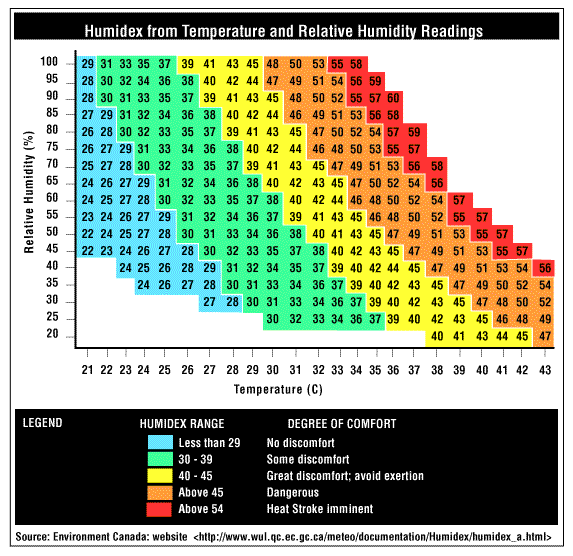
Like really, don't you know that high humidity increases the "feeling" of temperature?
27C with 70% humidity feels like 35C.
Re: bosaso becoming the new moqdishu
bal eega this cuqdad written sii-bakhti even what allah swt and nature has given us ayuu inoo diidanyahay dadkaas ayaa aduunka ku nool.
Re: bosaso becoming the new moqdishu
What cuqdad you're talking about? Does it hurt you to state facts.
You can dance around your AMISOM infested shithole until the next explosion for all I care.
PS Did you figure out yet wither your beloved cluster city is located on the equator or not?

You can dance around your AMISOM infested shithole until the next explosion for all I care.
PS Did you figure out yet wither your beloved cluster city is located on the equator or not?
-
Snailland12

- Posts: 217
- Joined: Tue Mar 01, 2016 10:37 am
Re: bosaso becoming the new moqdishu
i can already tell what smooth's reponse will be:
"That bermuda triangle has again stolen from the proud hawiye people. They have built that city on the blood of our kind. It wont last, mogdishu dispite its constant attacks by the bermuda triangle, is thriving. Those bermuda triangle have taken our cattle, and built their city with it. I hate them, i hate puntland, i hate that bermuda triangle, blah blah blah"
Its really sad to see some guy in london spend all his time attacking others for his own clans pitful existance, he honesly gives mjs superpowers in the way he describes them, Its always another clans fault for his people living under the bantu foot.
Im not even darod, but will give were credit is due, i just dislike, people like that sad mentally disturbed reject.
"That bermuda triangle has again stolen from the proud hawiye people. They have built that city on the blood of our kind. It wont last, mogdishu dispite its constant attacks by the bermuda triangle, is thriving. Those bermuda triangle have taken our cattle, and built their city with it. I hate them, i hate puntland, i hate that bermuda triangle, blah blah blah"
Its really sad to see some guy in london spend all his time attacking others for his own clans pitful existance, he honesly gives mjs superpowers in the way he describes them, Its always another clans fault for his people living under the bantu foot.
Im not even darod, but will give were credit is due, i just dislike, people like that sad mentally disturbed reject.

Re: bosaso becoming the new moqdishu
I don't know if Xamar was always hot but everyone that goes there tells me it's super hot and humid off course it beats both Bosaaso and Berbera.

Re: bosaso becoming the new moqdishu
All coastal areas are hot xamar and kismayo no different actually kismayo is way too hot because so close to equator the cool side for somali lands is somaliland mountain range that's it.blood wrote:Both these Cities Lie Near the Equator and the average temp in Mogadishu is 23-24 that is below room temperature!! the only hot month is march and half of april,climate change has propelled these two cities to experience Milder equotorial status of rain and cold.!barbarossa wrote:Rambie wrote:Mogadishu and Kismayo are warm, barley cooler than Bosasso.
I found out it's a myth that southern Somalia is a cool mild place.
http://en.climate-data.org/location/898/
http://en.climate-data.org/location/856/
http://fr.climate-data.org/location/872/
You are right, the variation, in temperature, could scarcely amount to no more than few degrees, but, at least, in Mogadishu and Kismayo, residents are not forced to abandon their homes for quarter of the year, solely due to unbearable heat. Mogadishu and Kismayo, are both far better situated than Bosaaso, in terms of providing a conducive and comfortable living environment.
the whole south is hot due low elevation and closer to equator all I can imagine of it is shitt flys and mosquitos bugging shitt out u a complete shit hole I don't know how hell ahmed madoobe went from raas kamboni to kismayo that's straight desert coast shit looks like surface of mars.
Re: bosaso becoming the new moqdishu
Everything on the coast is hot that's why they call it xeebta you going come out sunbaked and burnt I bet you Italians use to bring tub of sun block to xamar even Italians didn't live in xamar majority of them use to live countryside instead.Siciid85 wrote:I don't know if Xamar was always hot but everyone that goes there tells me it's super hot and humid off course it beats both Bosaaso and Berbera.
Last edited by JSL3000 on Sun Apr 17, 2016 10:26 pm, edited 2 times in total.
Re: bosaso becoming the new moqdishu
Guban can you believe my tullo is the hottest place I found in SLAND so far
aside from the coast? Almost all other inland towns and cities in SLAND are mild and some very cold.
This is Burco averaging 23C.
http://en.climate-data.org/location/907/
aside from the coast? Almost all other inland towns and cities in SLAND are mild and some very cold.
This is Burco averaging 23C.
http://en.climate-data.org/location/907/
Re: bosaso becoming the new moqdishu
for real I thought caynabo or laascaanood would be hotter than burco.Rambie wrote:Guban can you believe my tullo is the hottest place I found in SLAND so far
aside from the coast? Almost all other inland towns and cities in SLAND are mild and some very cold.
This is Burco averaging 23C.
http://en.climate-data.org/location/907/
Re: bosaso becoming the new moqdishu
You're right they're slightly hotter at 24.2 C but still cooler than any other southern town so far.
http://en.climate-data.org/location/56164/
http://en.climate-data.org/location/5996/
Check Ceel Afweyne
http://en.climate-data.org/location/56210/
http://en.climate-data.org/location/56164/
http://en.climate-data.org/location/5996/
Check Ceel Afweyne
http://en.climate-data.org/location/56210/
Re: bosaso becoming the new moqdishu
Hands down the coolest town in SLAND.
Ceerigabo averaging 17.2 C
http://en.climate-data.org/location/904/
Ceerigabo averaging 17.2 C
http://en.climate-data.org/location/904/
Re: bosaso becoming the new moqdishu
The best weather I think is sheekh mountain range and towns around sanaag mountain range like yufle last summer, anywhere close to go listen range in somaliland. I was in allaybaday so cool and relaxed anywhere close mountain ranges and deep inland to the west somaliland got the best weather.
Somaliland climate is much cooler and mild than somalia and xamar was only made capital of former somali republic because of the infrastructure left by the Italians besides that the capital can moved to remote place it doesn't have significant value anymore.
Somaliland climate is much cooler and mild than somalia and xamar was only made capital of former somali republic because of the infrastructure left by the Italians besides that the capital can moved to remote place it doesn't have significant value anymore.
-
- Similar Topics
- Replies
- Views
- Last post
-
- 0 Replies
- 989 Views
-
Last post by michael_ital
-
- 13 Replies
- 823 Views
-
Last post by Addoow
-
- 22 Replies
- 1110 Views
-
Last post by abdi ilyas
-
- 30 Replies
- 1395 Views
-
Last post by The_Emperior5
-
- 0 Replies
- 298 Views
-
Last post by Siciid85
-
- 5 Replies
- 699 Views
-
Last post by grandpakhalif
-
- 9 Replies
- 52 Views
-
Last post by AbdiWahab252
-
- 0 Replies
- 2 Views
-
Last post by MarsinQorahay
-
- 2 Replies
- 678 Views
-
Last post by AbuShabab